
If you’ve just found out you’re expecting two little bundles of joy instead of one, CONGRATS! 🥳
Double the joy… and double the questions! Not to worry, we’re here to help.
Here’s a simple breakdown of the most common types of twins.
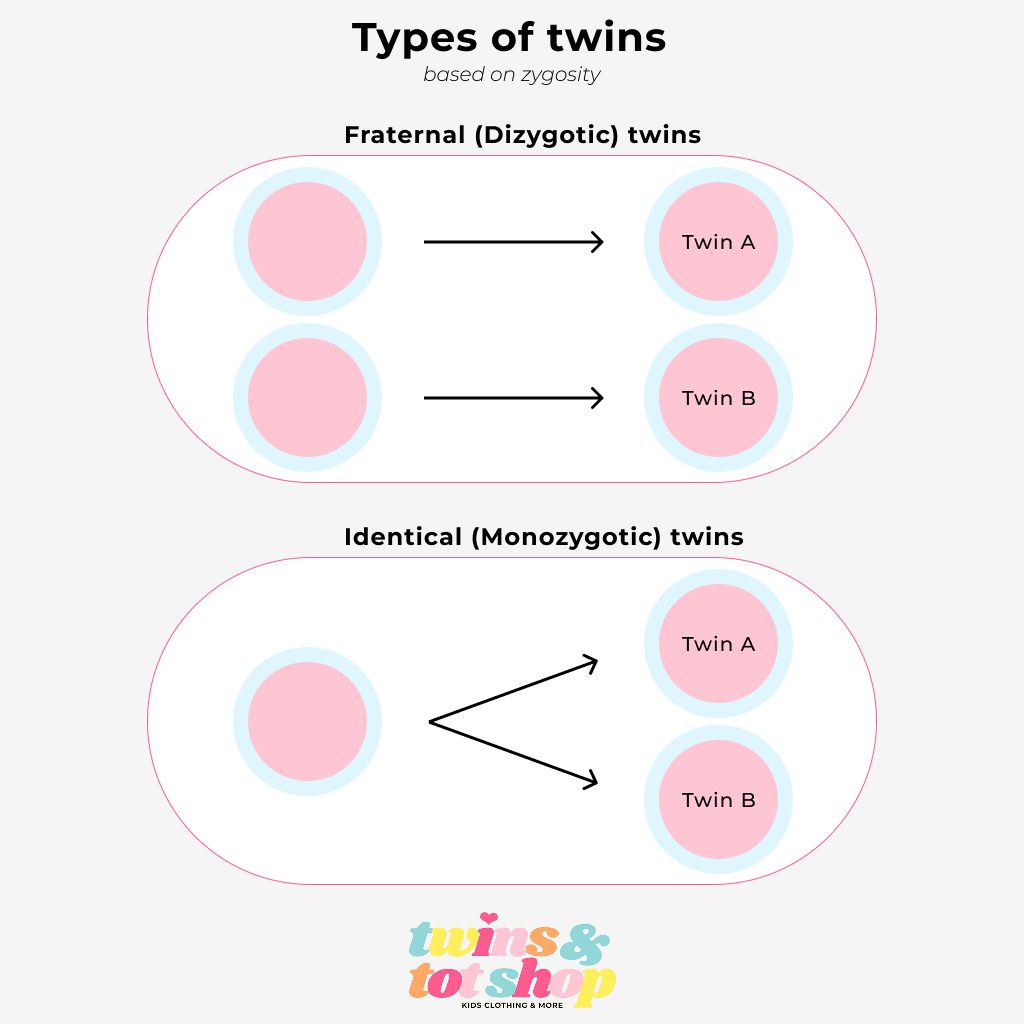
Fraternal twins (Dizygotic)
Fraternal or non-identical twins are the most common type of twins worldwide. These two are more like regular siblings who just decided to rent the womb at the same time. Fraternal twins share only half of their genomes. The scientific term “dizygotic” refers to two different eggs, which are fertilized by two different sperm. This can happen because two eggs were released by the ovaries instead of just one.
Fun facts:
– Can be the same or different sexes
– No more alike than any other siblings
Identical twins (Monozygotic)
These two are the ultimate copy-paste. Identical twins come from one fertilized egg (monozygotic) that splits into two. Basically, the body said, “Let’s make a human!” and then “Make it a double!” They share all the same genetic material and are genetically identical. They usually look super similar, but their personalities can be as different as ketchup and mustard.
Fun facts:
– Same sex
– Same DNA
Mirror twins
These twins are a rare, quirky sub-type of identical twins. They originate from the same egg, but the egg splits a little later than usual, and the twins develop as mirror images of each other. Think: one’s a lefty, the other’s a righty; one has a freckle on the left cheek, the other on the right; opposite birthmarks. Basically, it’s like nature decided to have some fun with symmetry.
Conjoined twins
Conjoined twins are also a sub-type of identical twins. They are born with their bodies physically connected. Doctors do not fully understand how this occurs but there are theories, such as the identical twin egg not splitting fully. This complicated phenomenon is extremely rare.
There are other types of twins but the ones listed above are the most common.
MoMo, MoDi and DiDi twins (huh?)
Don’t worry, this isn’t a new language you missed on Duolingo. Twinning is quite complex, so there are a few terms that doctors use to describe how twins are set up in the womb.
Fraternal and identical are categories of twins based on the number of eggs (something called zygosity), but twins can also be categorised based on chorionicity and amnionicity.
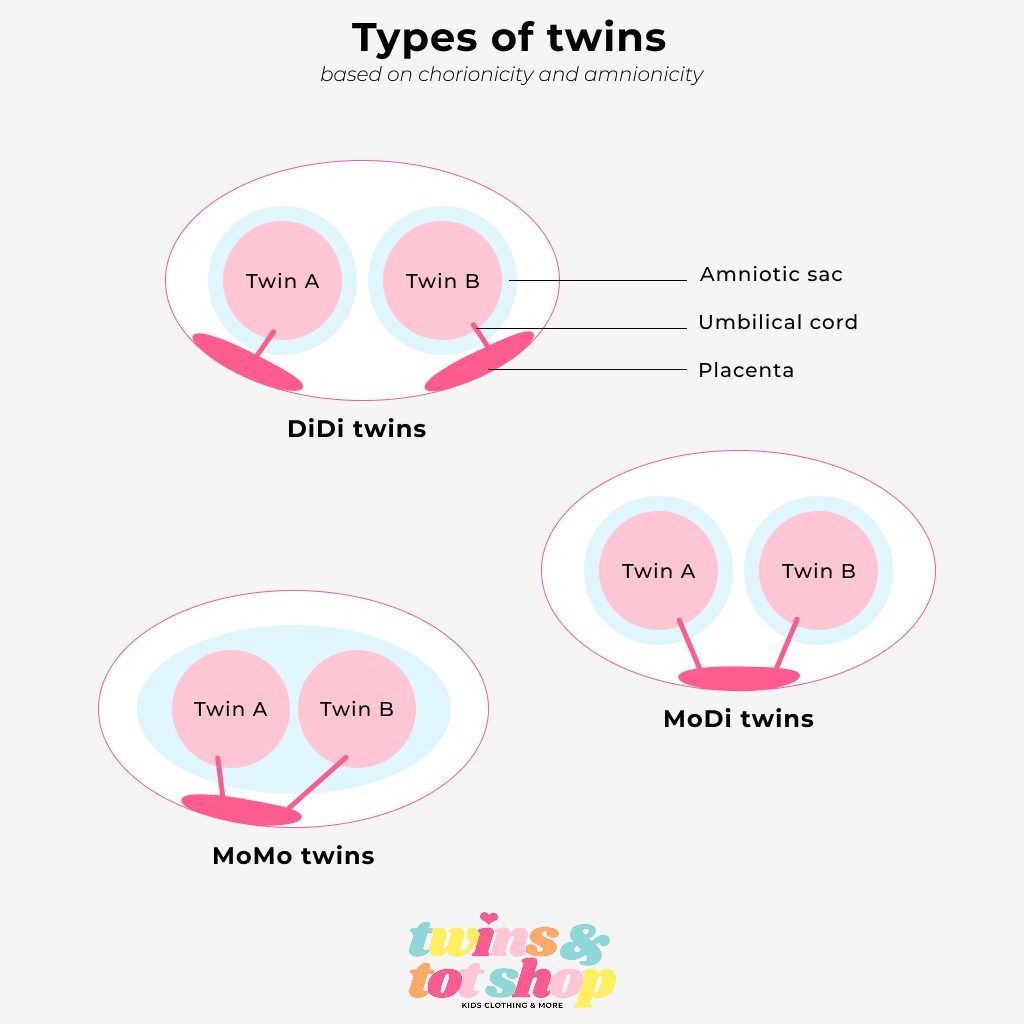
These terms describe how the twins share the placenta and amniotic sacs. “Monochorionic” means a single placenta, whereas “Dichorionic” means two. Monoamniotic” means one sac, whereas “Diamniotic” means two. Simple, right? 😆
There are three possible combinations of sacs and placentas:
- DiDi (Dichorionic/Diamniotic)
Two placentas, two sacs. Like next-door neighbours with their own rooms. They are the most common form of twins and can be either identical or fraternal. - MoDi (Monochorionic/Diamniotic)
One placenta, two sacs. Basically housemates that share snacks, but sleep in separate rooms. MoDi twins are always identical. - MoMo (Monochorionic/Monoamniotic)
One placenta, one sac. Very close roommates that share everything. MoMo twins are also always identical.
Summary
Types of twins based on zygosity:
fraternal and identical (including mirror, conjoined and more)
Types of twins based on chorionicity and amnionicity:
MoMo, MoDi and DiDi
Frequently asked questions about twins
Ah, a classic question that makes every fraternal twin mom want to scream into a pillow 😅 Identical twins are genetically identical. This means they have the same DNA and therefore, the same sex. There are incredibly rare exceptions due to genetic anomalies, but for the everyday encounter, it’s highly unlikely that you’ll meet boy-girl twins that are identical. So essentially, no.
Identical twins come from one fertilized egg that splits into two embryos, meaning they share the same DNA.
Fraternal twins come from two separate eggs fertilized by two different sperm, making them genetically similar to regular siblings.
Some clues include:
Sex: identical twins are always the same sex, while fraternal twins can be different sexes.
Appearance: identical twins usually look extremely similar.
Placenta and sacs: ultrasound during pregnancy may give clues.
DNA testing: the most accurate way to confirm.
Yes. Fraternal twins can sometimes look very similar, especially if they share many physical traits. However, genetically they are no more alike than regular siblings.
Yes. Identical twins come from the same fertilized egg, so they share the same chromosomes and are always the same sex.
Absolutely! Even though they share the same DNA, identical twins can develop different personalities, interests and preferences.
Fraternal twins are more common than identical twins. Factors such as age, genetics, and fertility treatments can increase the chances of fraternal twins.
Irish twins are siblings born within 12 months of each other. They are babies born from two completely different pregnancies, they’re not actually twins! Hopefully this clears up any confusion if you’ve heard of these “twins” before 🤣
What does this all mean for you?
Whether your twins are identical or fraternal, MoMo, MoDi or DiDi, you’re about to experience double the kicks, double the laundry and of course, double the love!
It might sound cliché, but honestly, nothing compares to the magic of twins.
Just remember: you’ve got this.
And there’s an entire twin parent community (and coffee) to support you along the way 💪💕
So, are you ready for twins? Take this fun quiz to find out
Sources
National Human Genome Research Institute, Fraternal Twins, 2025
National Human Genome Research Institute, Identical Twins, 2025
Afzal AR, Montero FJ, Conjoined Twins, 2023
Farvardin H, Maalhagh M, Farvardin M, Mirror image hypermetropic anisometropia in a pair of monozygotic twins, 2019